

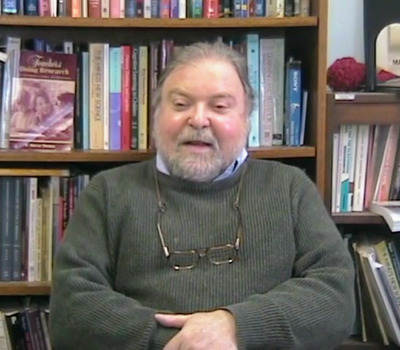
-
Allen, Terry L. Interview 6 May 2025
Terry Allen, Maughn Rollins Gregory, and Megan Jane Laverty
In this IAPC Oral History interview, veteran teacher Terry L. Allen tells about learning philosophy for children from a class he took from Dale Cannon at the University of Washington in Oregon while teaching school in Salem, Oregon (see attached articles). He describes his masters and doctoral degrees in philosophy for children at Montclair State University – including his memories of Matthew Lipman, Ann Margaret Sharp, and David Kennedy – culminating in his doctoral dissertation, Exploring Worldview Perspectives with 8th Grade Students: Criteria-Mapping as a Method of Value Disclosure and Worldview Discovery.Allen discusses his 32 teaching at Eastern Christian Middle School in Wyckoff, New Jersey, where he practices a “Pedagogy of Asking,” to engage young people in philosophical dialogue in a community of inquiry to work out their own beliefs and values.
-
Berman, Matthew L. Interview 14 April 2025
Matthew L. Berman, Maughn Rollins Gregory, and Megan Jane Laverty
In this IAPC Oral History Interview, Mathew "Matt" L. Berman describes his experience as a student in the Masters of Arts in Teaching Philosophy for Children program at Montclair State College in the 1980s, his use of philosophy as a teacher at the Metairie Park Country Day School in Metairie, Louisiana, and the database of Philosophy and Children’s Literature he created during his 1989 sabbatical funded by the “Teacher-Scholar Program for Elementary and Secondary School Teachers,” awarded by the National Endowment for the Humanities.
-
Cam, Philip Interview 27 May 2025
Philip Cam
In this IAPC Oral History Interview, Philip Cam, Honorary Associate Professor in the School of Humanities and Languages at the University of New South Wales, reflects on his intellectual, professional, and personal journey into philosophy and philosophy for children (P4C). Beginning with his early identity as an artist and secondary school art teacher in Australia, Cam recounts his gradual turn toward philosophy through formative encounters with books, mentors, and academic study in philosophy and psychology. He describes his involvement with P4C as a recovery of childhood curiosity and a way of uniting teaching, philosophical inquiry, and humane education. Cam discusses his early engagement with the IAPC, including his time at the IAPC Seminar at Mendham, New Jersey, his collaboration with figures such as Matthew Lipman and Ann Margaret Sharp, and the tensions between philosophy as an academic discipline and philosophy as a pedagogical practice. He reflects on curriculum development, teacher education, and the creation of classroom materials, as well as the global spread of P4C through workshops across Europe, Asia, and Australia. The interview concludes with Cam’s reflections on education, dialogue, intellectual community, and his later return to art, emphasizing philosophy as a lived, social practice at the heart of democratic and humane schooling.
-

Dianuzzo, Nicholas Interview 17 April 2025
Nicholas Dianuzzo, Maughn Rollins Gregory, and Megan Jane Laverty
In this interview Professor Nicholas Dianuzzo describes his recovery from drug dependency, his undergraduate study of philosophy and his experience in the Master of Arts in Teaching Middle School Philosophy at Montclair State College. At the time, he was counseling drug-dependent teenagers and was the first person to use philosophy to do so--an approach he developed in consultation with Colin Clayton, whom he met at the IAPC Summer Course at Mendham, New Jersey, and who became one of the first practitioners of philosophical counseling in the UK. In October 1992 Dianuzzo and Clayton presented their work at the 5th International Conference on Philosophy for Children at the University of Graz. In 1996 Dianuzzo and Matthew Lipman were interviewed about this approach on the public television program Ethics in the 90s (see that episode here).
-
Gazzard, Ann Interview 8 August 2018
Ann Gazzard and Peter Shea
In this IAPC Oral History Interview, Dr. Ann Gazzard describes studying with Gareth B. Matthews at the University of Massachusetts, Amherst, and later working for eight years at the Institute the Advancement of Philosophy for Children, where she conducted research, wrote curriculum, and traveled around the United States conducting teacher workshops, before joining the philosophy faculty at Wagner College. She describes the different roles of Matthew Lipman and Ann Margaret Sharp at the Institute. She later gave workshops on emotional intelligence for parents using philosophical discussion at an early childhood center. She discusses relationships among yoga, meditation, and philosophy for children.
-
Guin, Philip C. Interview 1 December 2005
Philip C. Guin and Peter Shea
Philip C. Guin was the Director of Teacher Education Services at the Institute for the Advancement of Philosophy for Children (IAPC) at Montclair State College (later University) from 1978 through 2000. He was interviewed on video camera by Peter Shea at the IAPC on December 1, 2005 as part of the IAPC Oral History Project. In the interview, Guin describes his own education in philosophy, how he discovered philosophy for children, and his work preparing teachers to implement the program, in New Jersey and across the United States. He reflects on the impact of doing philosophy on children’s thinking and character. The interview was broadcast on the regional cable and online interview show The Bat of Minerva, which Shea produced and directed for over two decades, with support from the Institute for Advanced Study at the University of Minnesota. It was transcribed, edited, and annotated by Maughn Rollins Gregory.
-

Heinegg, James Interview 18 April 2025
James Heinegg, Maughn Rollins Gregory, and Megan Jane Laverty
In this interview, James Heinegg reflects on his formative involvement with the Institute for the Advancement of Philosophy for Children (IAPC), beginning with his participation in the Master of Arts in Teaching program with a concentration in Philosophy for Children at Montclair State College during the 1988–1989 academic year. Heinegg describes the structure of the MAT program—including residential sessions in Mendham, New Jersey, and supervised philosophy teaching in Montclair and Newark public schools—and the pedagogical practices of the community of inquiry as they were taught and enacted at the time. He discusses his subsequent work as a full-time and part-time Program Assistant at the IAPC, detailing his responsibilities in teaching, mentoring students, editorial work for Thinking: The Journal of Philosophy for Children, and supporting the Institute’s international programs. Heinegg offers rich reflections on the mentorship of Matthew Lipman and Ann Margaret Sharp, emphasizing their commitment to community, collaboration, and philosophical inquiry. The interview also traces Heinegg’s later career as an elementary school teacher, director of curriculum instruction, and school district superintendent, highlighting the enduring influence of philosophy for children on his educational leadership and curriculum work.
-
Jackson, Thomas E. Interview May 2024
Thomas E. Jackson and Maughn Rollins Gregory
In this interview, Dr. Thomas E. Jackson talks about philosophical wonder he experienced as a child around the experience of suffering, and how that followed him into his university studies. He describes his undergraduate and masters studies in medicine, psychology, and philosophy at the University of Toledo, and his formative encounter with Professor Ramakrishna Puligandla, who introduced him to Hindu and Buddhist philosophy and contemplative practices. Jackson took his PhD in comparative Asian and Western philosophy at the University of Hawai’i, after which he co-founded the Hawaiian international film festival. After meeting Dr. Barry Curtis, who had introduced philosophy for children on Hawai’i’s “Big Island,” from the University of Hawai’i’s Hilo campus in 1978, Jackson attended the three-week summer seminar in philosophy for children in Mendham, New Jersey, run by the Institute for the Advancement of Philosophy for Children (IAPC) at Montclair State College. There he met and was mentored by Matthew Lipman and Ann Margaret Sharp. Jackson brought “small-p” philosophy to schools in and around Honolulu as a faculty specialist in the philosophy department at the University of Hawai’i, Manoa. He discovered commonalities between philosophy for children and Hawaiian culture and found ways to adapt the former to the latter. He created a unique philosophy in the schools program, “P4C Hawai’i,” which was funded by the Hawaiian Department of Education for many years. In the program, teachers facilitated philosophy sessions once each week on their own, and another time with a visiting philosopher or philosophy graduate student. Teachers also met together once a week for a “Philosophy for Teachers” session and received university credit. Jackson created a university course to prepare philosophy graduate students to work in the program and invented several innovations to the Montclair model, including “magic words” like IDUS (I don’t understand), the WRAITEC: The Good Thinker’s Toolkit, and a Philosophy in Schools Startup Kit. https://p4chawaii.org/wp-content/uploads/colvin.pdf”> In 1995 Jackson conducted the first philosophy for children workshop in China. He mentored the first doctoral dissertations on philosophy for children to come from the University of Hawai’i’s philosophy department. In 2005 Jackson met Mr. Eiji Uehiro, founder of the Uehiro Foundation on Ethics and Education in Tokyo, Japan, who offered support for P4C Hawai’i and in 2012 the Foundation gifted $1.25 million to fund https://p4chawaii.org/”>The University of Hawaiʻi at Mānoa Uehiro Academy for Philosophy and Ethics in Education.
-
Lipman, Karen Interview 22 August 2023
Karen Lipman, Peter Shea, Maughn Rollins Gregory, and Walter Omar Kohan
Karen Lipman is the daughter of Matthew Lipman, co-founder of the Institute for the Advancement of Philosophy for Children at Montclair State University, and Wynona Moore Lipman, the first African-American female Senator of the State of New Jersey. In this interview by Peter Shea, Maughn Rollins Gregory, and Walter O. Kohan, Karen shares memories of her parents and talks about what she learned from each of them. This interview was conducted on 22 August 2023 in preparation for the international celebration of Matthew Lipman's Centenary two days later.
-
Lipman, Matthew Interview 13 November 2008
Matthew Lipman and Peter Shea
In this last interview of his life, given at the age of eighty-five, Matthew Lipman reflects on the development of philosophy for children. He revisits the formative period of the late 1970s and early 1980s, when the Institute for the Advancement of Philosophy for Children was consolidating its curriculum and training practices. Central to the interview is Lipman’s meditation on Harry Stottlemeier’s Discovery as a breakthrough text that demonstrated the possibility of cultivating philosophic thinking through narrative, even before its underlying principles could be fully articulated. He describes philosophy as a practice that is grasped through immersion rather than explicit instruction, employing vivid metaphors—most notably philosophy as a “passport” that enables intellectual travel across domains of experience and culture. Lipman also discusses subsequent novels (Lisa and Suki) as reiterations of a single project: helping readers come into a new relationship with language as it is elemental to logic, ethics, and aesthetics. Throughout, the interview illuminates Lipman’s enduring concern with how philosophic competence is recognized, fostered, and lived, even when its essential elements resist precise formulation.
-
Lyell, Elizabeth Interview 21 November 2025
Elizabeth Lyell, Maughn Rollins Gregory, and Megan Jane Laverty
In this IAPC Oral History Interview, Dr. Elizabeth Lyell reflects on her participation in the first cohort of the Master of Arts in Teaching degree with a Concentration in Philosophy for Children at Montclair State College during the 1981–1982 academic year. Lyell recounts her introduction to philosophy for children, her intensive year of study with Matthew Lipman, Ann Margaret Sharp, and Phil Guin, and teaching philosophy in public school classrooms in Montclair, New Jersey and Harlem. Lyell offers vivid memories of Lipman as a teacher, mentor, and moral presence, highlighting his pedagogical generosity, seriousness, and commitment to grounding philosophy in lived experience. The interview traces her subsequent career teaching philosophy for children, training teachers, working in higher education and adult education, and later counseling, demonstrating the lasting influence of philosophy for children on her professional and personal life. In 2002 Lyell accompanied Lipman to receive the American Philosophical Association Innovation Prize.
-
Matkowski, Joanne Interview 2012
Joanne Matkowski and Peter Shea
Joanne Matkowski was a business major hired as a student worker at the IAPC in 1980. On graduation she became an office manager and eventually Assistant Director of the Institute. For over three decades, she handled purchasing, printing and sales of the IAPC curriculum and the journal 'Thinking', managed the Institute’s budget, communicated with university administrators, and assisted faculty members, graduate students, and visiting scholars to the IAPC. Joanne developed close relationships with many of these, especially Matthew Lipman, with whom she interacted the most.
-

Michelli, Nicholas M. Interview 24 April 2025
Nicholas M. Michelli, Maughn Rollins Gregory, and Megan Jane Laverty
In this interview, Nicholas M. Michelli, former Dean of the College of Education and Human Services at Montclair State University and a leading advocate of critical thinking, civic education, and education for democracy, reflects on his career and his involvement with the Institute for the Advancement of Philosophy for Children (IAPC). He describes his early encounters with Matthew Lipman and Ann Margaret Sharp, and key moments in the founding, expansion, and internationalization of the IAPC, including teacher-training initiatives, state and federal recognition, graduate and doctoral programs, and international partnerships. Throughout the interview, Michelli emphasizes the inseparability of philosophy, critical thinking, and civic education, framing them as essential to democratic life and social justice. He also reflects candidly on tensions between philosophers and educators, the challenges of institutional politics, and the contemporary urgency of democratic education amid national and global political instability.
-
Morehouse, Richard E. Interview 6 November 2025
Richard Morehouse, Peter Shea, and Maughn Rollins Gregory
In this IAPC Oral History Interview, Richard “Mort” Morehouse reflects on his formative role in the development of philosophy for children (P4C), the community of inquiry, and the institutional histories that shaped them. He traces his entry into P4C through gifted education and curriculum reform in the late 1960s, highlighting the influence of teacher education and educational psychology on his work. The interview documents the origins and evolution of "Analytic Teaching" (now Analytic Teaching and Philosophical Praxis) and the North American Association for Community of Inquiry (NAACI), situating them within debates over pluralistic approaches to P4C. Throughout, Morehouse offers a reflective, candid account of the contingencies, collaborations, and values that have shaped philosophy for children as an international educational movement.
-
Oyler, Joe Interview August 2019
Joe Oyler and Peter Shea
In this 2019 interview, Dr. Joe Oyler reflects on his professional trajectory from doctoral research in dialogic teaching and philosophy for children to a faculty position at Maynooth University in Ireland. He describes the formative influence of sustained work with teachers, school partnerships, and the Institute for the Advancement of Philosophy for Children community, alongside the tensions between administrative responsibilities and a desire to pursue classroom-based research. The interview traces Oyler’s decision to leave the United States academic context, the opportunities presented by Ireland’s evolving educational landscape, and the emergence of philosophy as a sanctioned subject within secondary education. Central themes include dialogic pedagogy, inclusivity, open-ended inquiry, and the role of the teacher as facilitator rather than authoritative expert. Oyler articulates cautious optimism about embedding philosophy for children values within Irish teacher education and professional development, while remaining sensitive to issues of authority and advocacy as an academic outsider. The latter part of the interview focuses on Oyler’s research agenda, particularly the challenge of empirically identifying what is distinctive about philosophical inquiry as compared with other forms of critical and dialogic thinking. He outlines an ambitious vision for mapping conceptions of philosophy across pre-college programs and developing empirical measures of philosophical quality in educational practice.
-
Oyler, Joe Interview November 2008
Joe Oyler and Peter Shea
In this interview, Joe Oyler reflects on his participation in the Master of Arts in Teaching program with a concentration in Philosophy for Children and the Doctor of Education in Pedagogy and Philosophy at Montclair State University and his work as a Graduate Assistant at the Institute for the Advancement of Philosophy for Children. He reflects on the contemporary state of education and the benefits and challenges of bringing philosophy to American public schools.
-

Pacillo-Dellino, Maria Interview
Maria Pacillo-Dellino
Maria Pacillo-Dellino earned the Master of Education, Concentration in Philosophy for Children (2003), and the Doctor of Education in Pedagogy and Philosophy (2010) at Montclair State University, during which time she was a Graduate Assistant for the Institute for the Advancement of Philosophy for Children and an adjunct professor at the University. (Her doctoral dissertation, Community of Inquiry and the Intersection of Epistemology and Pedagogy: A Grounded Theory Analysis, is available on the IAPC Digital Commons: https://digitalcommons.montclair.edu/etd/239/.) In this interview she describes doing philosophy in Montclair public schools, being an editor for Thinking: The Journal of Philosophy for Children, and how her graduate studies informed her career as a philosophy teacher.
-
Pardales, Michael J. Interview 15 May 2025
Michael J. Pardales and Maughn Rollins Gregory
In this IAPC Oral History Interview, Michael J. Pardales, Ph.D. reflects on his professional trajectory and sustained engagement with Philosophy for Children (P4C). He recounts his initial turn from pre-medicine to philosophy and his subsequent discovery of P4C through undergraduate study at Michigan State University. He describes his graduate experience in the Philosophy for Children program at Montclair State University (1992–1993) and the formative influence of the Institute for the Advancement of Philosophy for Children (IAPC) seminars at Mendham, New Jersey. He offers vivid recollections of Matthew Lipman and Ann Margaret Sharp as educators, highlighting Lipman’s distinctive integration of philosophy, curriculum design, and pedagogy, and Sharp’s passionate commitment to early childhood philosophy. The interview also details Pardales’ early classroom experiences, including student teaching and a challenging year teaching fourth grade in a residential school for emotionally impaired students, where he integrated philosophical activities into the broader curriculum. Pardales reflects critically on the possibilities and limits of implementing philosophy in schools, particularly under conditions of standardized testing and high-stakes accountability, while underscoring the transformative potential of philosophical inquiry for students often marginalized by conventional educational settings.
-
Pritchard, Michael Interview 13 September 2023
Michael Pritchard, Maughn Gregory, and Peter Shea
In this IAPC Oral History Interview, Michael Pritchard discusses his career as a philosopher specializing in ethics, moral psychology, and precollege philosophy. He describes using children's books to teach university philosophy classes and his involvement with the first doctoral program in philosophy for children at Universidad Iberoamericana in Mexico City. He shares his views on children's moral education. Pritchard's books include Philosophical Adventures with Children (University Press of America, 1985), Reasonable Children (University Press of Kansas, 1996), and On Becoming Reasonable (University Press of Kansas, 1991).
-

Strohecker, Margaret Interview 30 October 2025
Margaret Strohecker and Maughn Rollins Gregory
In this IAPC Oral History Interview, Margaret Strohecker reflects on her formative role in the early development and implementation of Philosophy for Children (P4C) in the United States. She recounts her introduction to P4C as an undergraduate philosophy student, her participation in the inaugural Master of Arts in Teaching program at Montclair State College in the early 1980s, and her experiences studying with Matthew Lipman, Ann Sharp, and other central figures of the IAPC. She offers detailed recollections of the IAPC seminars at Mendham, New Jersey, the structure and challenges of the early MAT program, and the communal intellectual culture fostered by Lipman and Sharp. Strohecker also discusses her subsequent work implementing P4C in public schools, particularly in Lynbrook, New York, addressing issues of teacher resistance, large-scale curricular implementation, assessment, and media attention. Through vivid anecdotes—especially classroom moments that reveal children’s emerging self-reflection—she articulates the pedagogical and ethical significance of philosophical inquiry with children. The interview further explores tensions between P4C and academic philosophy, questions of implementation across diverse educational contexts, and Strohecker’s later work in science education and homeschooling.
-
Weinstein, Mark Interview December 2005
Mark Weinstein and Peter Shea
In this 2005 IAPC Oral History Interview, Mark Weinstein reflects on more than three decades of involvement with Philosophy for Children (P4C), tracing his intellectual trajectory from formal logic to informal logic, critical thinking, argumentation theory, and educational practice. Weinstein recounts his leadership of the New York City Reasoning Skills Project and his role at Montclair State University in developing and administering graduate and doctoral programs in Philosophy for Children. He argues that the distinctive strength of P4C lies not in the delivery of discrete thinking skills but in its creation of a philosophically rich “universe of discourse” that empowers children’s voices through communities of inquiry. Weinstein candidly appraises Matthew Lipman’s intellectual genius, strategic opportunism, and enduring legacy, as well as Ann Sharp’s transformative contributions to the internationalization and theoretical expansion of the movement. Weinstein also addresses debates about critical thinking as skill versus disposition, the role of philosophy in education, and the limits of rationality in addressing acute social problems.
In 2004 the IAPC began an institutional history project. In addition to collecting and organizing an archive of documents, photographs, and video recordings, the Institute began collecting and creating written, audio, and video interviews of IAPC-affiliated faculty members, professional staff, visiting scholars, graduate students, and others involved in the work of the Institute since its founding in 1974. On this page of our Digital Archive, we share the audio- and video-recorded interviews. Anyone who wishes to contribute to this project may contact us at [email protected].
Printing is not supported at the primary Gallery Thumbnail page. Please first navigate to a specific Image before printing.