

It seems important to invite beginners to reflect on the kinds of interests and enthusiasm that lead people to spend their lives engaged with natural phenomena, to invite them to try on some of these ways of thinking. Often, hero stories point out differences between the heroes and ordinary people, celebrating the hero as an adult, in full mature splendor. But some stories show how a life-long interest began, how children persisted in their first questions and widened those questions over time. This might lead to a discussion of what starting points are present in each student’s life, in this classroom, and how those initial impulses might be pursued. Sometimes, people just need to know that it is possible for people like them to become interested in something in nature, and to pursue that interest in simple ways.
This sort of book isn’t much explored in philosophy for children practice, so we don’t have good information about how to approach it. The standard Mat Lipman approach is to read it and ask, “What’s worth talking about?” – and then work through the responses in a receptive way. Another thing to try: ask everyone, including the teacher or leader, to tell a story about a time when something in nature made them curious or interested. Then, read the book, and see how much the character’s way of thinking is like what came out in the stories. What questions do you have in common, and how might you investigate them. There might be interesting follow-up activities to try outdoors. Sometimes, a well told story of a curious person infects other people with a similar curiosity.
Here are some examples we found.
-
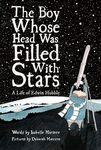
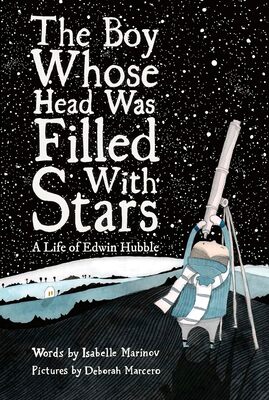
Boy Whose Head was Filled with Stars: A Life of Edwin Hubble (2021) by Isabelle Marinov
Maughn Rollins Gregory
Barely a hundred years ago, Edwin Hubble changed the way we understand the universe and our place in it more dramatically than almost anyone else has ever done. As this picture book biography shows, his mind-boggling discoveries can be traced back to childhood questions. The discovery that the world is bigger than we had imagined happens in many ways, and learning that we have some choices in deciding how new facts, new experiences, and new perspectives can matter to us is a necessary part of education.
-
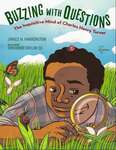
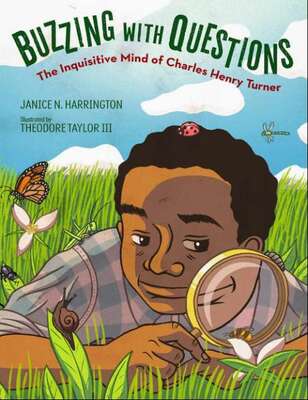
Buzzing with Questions: The Inquisitive Mind of Charles Henry Turner (2019) by Janice N. Harrington
Maughn Rollins Gregory
Do insects have minds? Are they creative? Can they tell time? Can they learn from experience? As a young boy, Charles Henry Turner couldn’t stop asking such questions and his curiosity-fueled intellect led him to become the first African American admitted to the St. Louis Academy of Science and one of the first entomologist to study insect behavior. By designing ingenious experiments, Turner proved that bees see color, that spiders can spin webs around artificial obstacles, that cockroaches can learn to navigate a maze, and that moths can be trained to beat their wings when a whistle blows. This insightful picture-book biography helps young readers trace the knowledge we find in science textbooks backwards through a process of experimental inquiry, to its source in human questioning. It also provokes important questions about the ethics of animal experiments.
-
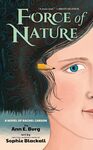
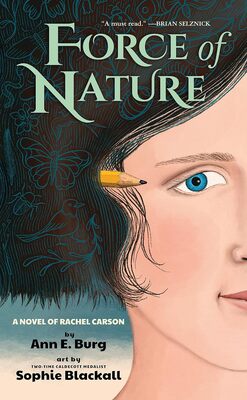
Force of Nature (2024) by Ann E. Burg
Maughn Rollins Gregory
Rachel Carson launched the modern environmental movement with books that combined detailed observations of the natural world, scientific research, and philosophical reflection on humanity’s relationship with nature — all conveyed in poetic language. Ann E. Burg’s fictional biography-in-verse Force of Nature shows how these habits of observation, questioning, reflection, and expression began in Carson’s childhood, and invites readers to follow her lines of inquiry. Can we provide for human well-being without sacrificing the well-being of non-human life? Can we provide for the well-being of certain human populations without sacrificing the well-being of others? Can we indulge our wonder about, and need to learn about nature without changing it? What role should ordinary citizens have in shaping the directions and applications of scientific research? What difference can one life, one voice make? Rachel Carson may not have offered definitive answers to these questions, but her life and writing articulated them powerfully.
-
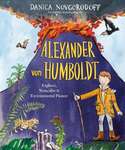
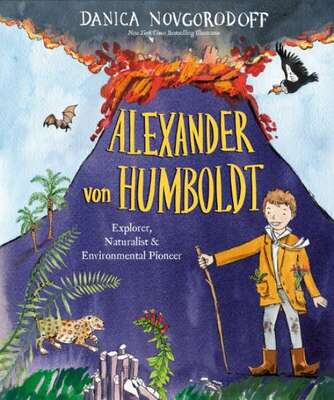
Alexander Von Humboldt: Explorer, Naturalist, and Environmental Pioneer (2019) by Danica Novgorodoff
Peter Shea
As a young boy, Alexander Von Humboldt came up with divergent questions about the birds and mountains and animals he saw, and brought all those questions together under two big questions that stayed important for him over a long life: “How are these things different?” and “How are they nevertheless connected?” As the reader watches Humboldt looking at a hawk and a mouse, volcanoes and farmland, palm trees and pine trees, Europe and Ecuador, Europeans and Indigenous people, one comes to expect what he will say: “They are different, and yet they are connected.” This idea is much bigger than “ecology”. For Humboldt, it was a key to making sense of experience generally. It’s is a way of thinking worth exploring in discussion: acknowledge difference, then find connection.