

Literature from most parts of the world, including children’s literature, features texts that describe human experiences in nature in terms of spirituality, transcendence, or reverence—terms which may connote the sacred or the supernatural. The authors of these kinds of texts addressed to children recognize that children can have such experiences with nature, and that such experiences can be an important part of the meaning of children’s lives.
Such children’s stories recommend attitudes or perspectives: paring down the ego, broadening one’s perspective, awakening awe and reverence, appreciating stillness, celebrating interconnectedness, being open to compassion. Some also describe methods for putting oneself in the way of such experiences, including rituals and holiday observances.
These stories invite philosophical reflection. What different qualities of experience are possible, and how might we name and describe them? What is the potential range of meanings for experiences with nature? What is the value of such experiences? Do they matter enough to try to arrange our lives to invite them more often? What might we have to change or exchange in order to do so?
There are two important but very different directions this kind of philosophical inquiry might take. One is to develop a common language for a kind of experience the children come to recognize as common to them, and perhaps to relate that language to cultural discourses on nature and spirituality represented in the text. The other is to help children recognize and appreciate impulses and experiences that are not widely shared, that may be particularly fragile. If led respectfully, philosophical reflection can help children maintain their differences and resist the provocation to always make public sense of everything. It could be especially useful in approaching spiritual responses to nature to begin a philosophical inquiry around a provocative text with a story circle: Tell a story about a time you had an experience similar to this.
Here are some books that might prompt this kind of conversation.
-
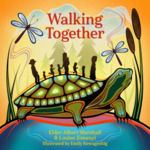
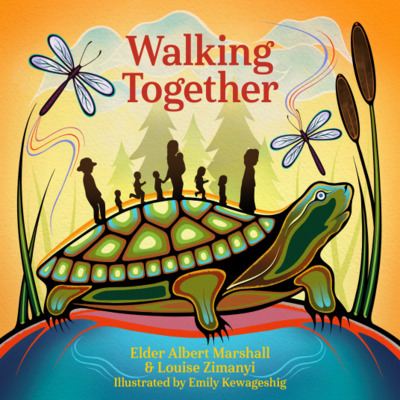
Walking Together (2023) by Elder Albert Marshall and Louise Zimanyi
Maughn Rollins Gregory
In the nineteenth and twentieth centuries American and Canadian government agencies and Christian churches established Indian residential schools where hundreds of thousands of children were “reeducated” in English and Christianity. They were not allowed to use their native languages or given names, to practice their religions, or to communicate with their siblings or parents. They were made to work in crop fields, kitchens, laundries, and industrial workshops. Many were physically and sexually abused. Many never saw their families again. The nine picture books reviewed here are accounts of survivors of residential schools from eight different Indigenous nations. In addition to depicting the violence attending these schools, the books show the courage and intelligent resilience of the resident children—inventing sign language to secretly communicate with each other, stealing food, and attempting escape. These books can help Indigenous families and descendants of settler colonizers explore this part of history in ways that may be uncomfortable but that will generate the kind of understanding of the past that can inform taking responsibility for the present and the future.
-
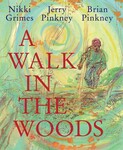
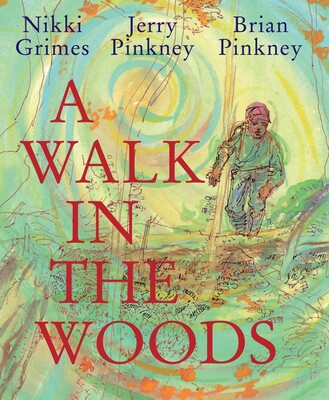
Walk in the Woods (2023) by Nikki Grimes
Maughn Rollins Gregory
An unnamed Black boy walks in the woods near his home a week after his father’s funeral. Because the boy knows how to be mindful in nature—to move slowly, step carefully, and pay close attention—he becomes more connected to the woods and the creatures in it. Rediscovering is his father’s legacy of ecstatic, aesthetic reverence for nature begins to assuage the boy's anger-tinged grief.
-
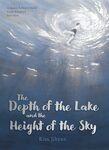
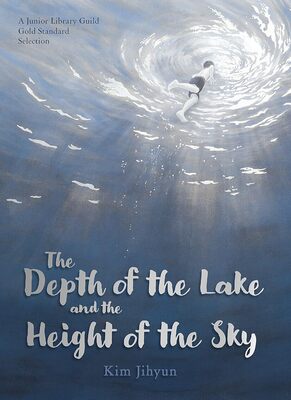
Depth of the Lake and the Height of the Sky (2017) by Kim Jihyun
Megan Jane Laverty
The Depth of the Lake and the Height of the Sky (2017) is KimJihyun’s first picture book; it is composed entirely of pictures. It “tells” the story of a young boy and his dog who spend a day swimming and sunbathing at a lake that is within walking distance from his grandparents' home, whom he is visiting with his parents. At first glance, the story might seem unremarkable, recounting an experience familiar to many. However, Kim’s illustrations challenge this assumption by drawing us into the boy’s encounter with nature. She creates a visual journey that guides us through a perceptual shift--one that inspires wonder at the extraordinariness of existence.
-
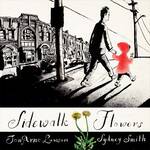
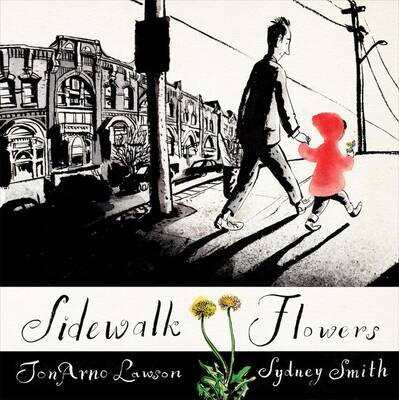
Sidewalk Flowers (2015) by JonArno Lawson
Samantha Piede
JonArno Lawson's Sidewalk Flowers centers on a little girl accompanying her father on a morning walk across a grey landscape. On the way, she spots dandelions sprouting out of the pavement. The protagonist's attention to this tiny, beautiful detail catalyzes her expanding appreciation for the rest of her environment, spurring her to notice beauty in unexpected places. This review suggests that Sidewalk Flowers richly introduces children to the philosophical theme of attention not with words, but with color.
-
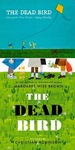
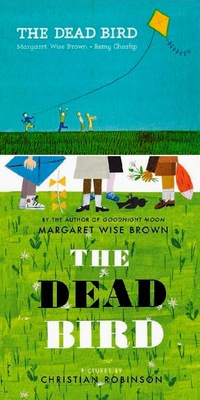
Dead Bird (1965/2016) by Margaret Wise Brown
Peter Shea
Children come upon a bird that has just died. It is still warm. They bury it, sing a song they have made up, and plant flowers. They visit the grave every day to put fresh flowers on it and to sing to the bird, until they forget. Margaret Wise Brown’s The Dead Bird is a story about how a new ritual happens, spontaneously, out of a shared experience of grief, expressing a shared reverence for one kind of life. The children are thinking, in a way: they are keeping something in mind for a long time, in a beautiful form. But their thinking is not investigation; it doesn’t make the kind of progress that an argument makes. Matthew Lipman’s starting question for philosophic discussion was always, “What’s worth talking about, here?” The Dead Bird may require more restraint from leaders than other stories, so that children can find their own ways into the realities of meaning-making and grief and poetry and shared experience. Different groups may find very different things worth talking about, in this small and exquisite story.